How K-Drama Is Becoming Part of India’s Everyday Streaming Culture
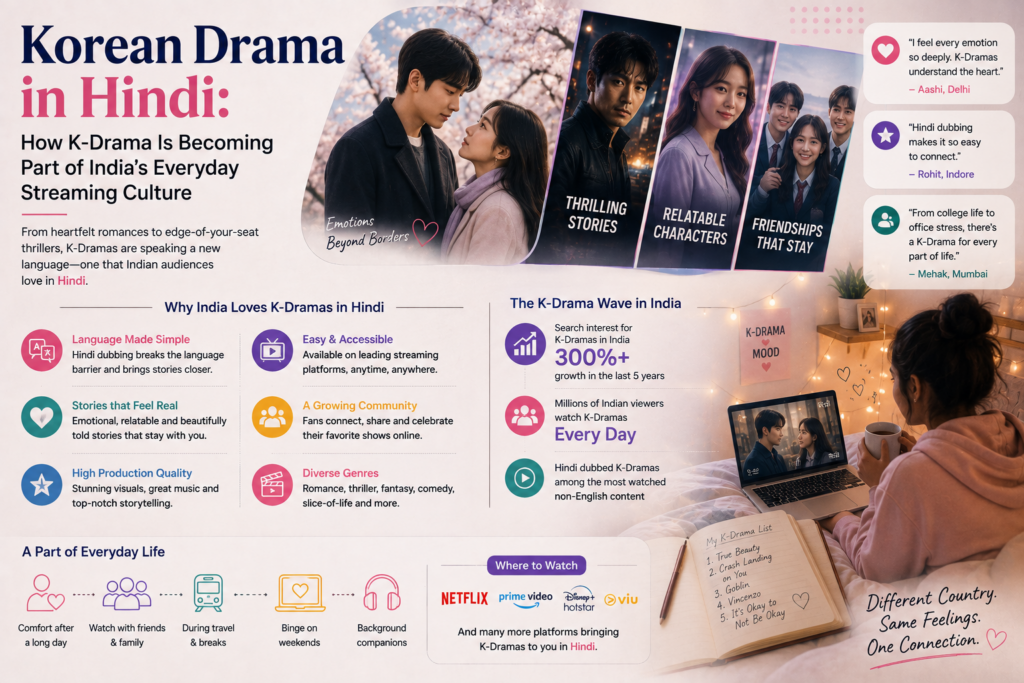
Korean drama has developed from a specialist international interest into a major part of the global streaming conversation, and India has become an increasingly important audience market. The appeal is no longer limited to viewers willing to follow Korean dialogue with subtitles. Hindi localization is making Korean television more approachable for a much wider audience, while streaming platforms are making international series easier to discover from a single digital catalog. For viewers searching for कोरियन ड्रामा हिंदी में, this combination of localization and on-demand access creates a convenient way to explore Korean entertainment through a familiar language.
From Korean Television to a Global Streaming Phenomenon
The international expansion of Korean drama is part of the wider rise of Korean popular culture. Music, television, cinema, fashion, and other forms of entertainment have increasingly crossed national borders, with streaming platforms playing a major role in introducing Korean productions to audiences that previously had limited access.
India has become an important part of that movement. In 2026, Korean content continued to attract significant attention from Indian streaming audiences, with major platforms regularly featuring Korean series within their international catalogs. Industry reporting has also noted that Indian viewers are increasingly exploring Asian entertainment beyond the traditional dominance of Korean productions.
This is an important transition. Korean drama is no longer necessarily something viewers have to discover through specialist communities or separate websites. It has become increasingly integrated into mainstream digital entertainment.
For Hindi-speaking audiences, localization adds another layer of accessibility.
Why Hindi Dubbing Matters
Subtitles have been essential to the international success of Korean drama, but they are not the only way to localize a series. Hindi dubbing allows viewers to follow dialogue in a familiar language without constantly dividing their attention between the action on screen and translated text.
This can make a considerable difference during longer viewing sessions. Viewers can concentrate on visual details, character interactions, production design, and other elements without having to read every line.
The Indian streaming market has responded to this preference. Amazon MX Player, for example, has promoted Korean dramas dubbed in Hindi and other Indian languages as part of its international entertainment offering.
More recently, major content partnerships have also emphasized Indian-language dubbing. A 2026 agreement between Prime Video India and Korean studio CJ ENM covers more than 100 Korean titles over two years, with Hindi, Tamil, and Telugu dubbing planned alongside English subtitles.
These developments indicate that Hindi localization is becoming a fundamental component of Korean content distribution in India rather than a niche feature.
The Appeal Goes Beyond Romance
International discussions about K-dramas often focus heavily on romance, but the Korean streaming catalog is considerably broader. Audiences can encounter crime, mystery, thriller, comedy, action, fantasy, family drama, historical productions, and hybrid genres that combine several traditions.
This variety is particularly valuable online because different viewers can approach Korean entertainment from completely different directions. Someone interested in suspense does not have to begin with romantic drama, while another viewer can explore comedy or fantasy without leaving the Korean category.
A well-designed catalog makes these differences visible. Genre shelves and curated collections allow viewers to understand the breadth of available Korean entertainment without having to research individual titles beforehand.
For Hindi-speaking audiences, language and genre can therefore work together as discovery tools. The viewer can look for Korean entertainment and then narrow the selection according to the type of series that fits the moment.
Korean Production Meets Indian Viewing Habits
One reason Korean drama travels so effectively is that its cultural identity remains visible even after localization. Hindi dubbing changes the language of access, but the Korean environment, visual style, social settings, fashion, food, architecture, and production aesthetics remain part of the experience.
This balance can make international entertainment feel both accessible and distinctive. The viewer does not have to choose between understanding the dialogue and experiencing something culturally different.
Digital distribution strengthens this relationship because it allows audiences to explore Korean entertainment at their own pace. There is no requirement to wait for a television channel to schedule a particular series or depend on a local broadcaster’s limited selection.
The result is a more natural form of cultural exchange. Korean entertainment can enter an Indian household through a Hindi-language interface while retaining its Korean character.
The Digital Catalog Is Changing Discovery
Traditional television required audiences to follow programming decisions made by broadcasters. Streaming reverses that relationship. The audience receives a catalog and decides where to go.
This makes the organization of Korean entertainment especially important. A growing collection can quickly become difficult to navigate if every title is presented in the same undifferentiated stream.
Genre categories, language information, curated collections, search functions, and recently added sections can provide useful routes through the catalog. Viewers who already know what they want can search directly, while those who are simply curious can browse.
This is particularly useful for Hindi-dubbed Korean drama because language preference is often the starting point. Once viewers identify the Hindi-language selection, they can explore genres and discover titles without having to navigate through unrelated international content.
The catalog therefore becomes part of the entertainment itself. Good organization turns browsing from a chore into a natural part of choosing what to watch.
A Simpler Path From Discovery to Playback
Streaming convenience is not only about availability. It is also about what happens between finding a title and starting it.
A platform can offer an extensive Korean catalog, but repeated registration requests, unnecessary redirects, and intrusive pop-ups can undermine the entire experience. Viewers should not have to complete a complicated process simply because they want to investigate a series.
Moviewala’s Hindi-oriented experience keeps this transition direct. Viewers can browse the catalog, select a Korean title from the shelf, and move toward playback without a mandatory registration wall. The clean interface also avoids distracting pop-ups, keeping attention on the content.
This is particularly useful when discovering unfamiliar Korean series. A viewer can explore one title, return to the shelf, investigate another genre, and make a decision without repeatedly encountering barriers.
One-click access makes the catalog feel more like an open digital library than a complicated portal.
Korean Drama Across Smart TVs and Mobile Devices
Korean drama is well suited to the multi-screen environment created by modern streaming. A Smart TV provides a comfortable setting for longer sessions, while laptops and desktop computers offer flexibility for individual viewing. Smartphones and tablets allow viewers to continue browsing and watching in more portable situations.
India’s broader OTT market has expanded significantly around these different devices. Ormax research cited in 2026 estimated India’s active connected-TV base at 129.2 million, while the overall OTT audience reached approximately 601 million.
This creates a diverse viewing environment for localized Korean entertainment. Some viewers may prefer Hindi-dubbed episodes on a large television, while others may use a smartphone for shorter sessions.
A modern streaming interface therefore needs to remain consistent across screens. The catalog should be easy to understand on a television and equally practical on a mobile display, with responsive navigation and straightforward playback controls.
The viewer should be able to change devices without having to learn a different version of the platform.
The Technology Behind International Streaming
Delivering Korean drama to Indian viewers involves a substantial technical infrastructure. High-quality video needs to travel across networks with different speeds and levels of congestion, while platforms may also need to manage multiple audio tracks, subtitles, metadata, and device specifications.
Compression technology helps reduce the amount of data required for high-quality video, while adaptive bitrate streaming can respond to changing network conditions. Content delivery networks distribute media across different geographic locations, helping reduce the distance between servers and viewers.
Localized content introduces additional complexity because the same series may contain Korean original audio, Hindi dubbing, English subtitles, and other language options.
The technical challenge is to make all of this feel simple. From the viewer’s perspective, the desired process is still just selecting a title, opening an episode, and watching with stable image and sound quality.
Korean Content Is Becoming More Multilingual in India
The growing emphasis on Hindi dubbing is part of a larger shift toward multilingual distribution. Korean content providers increasingly recognize that India cannot be treated as a single-language market.
The Prime Video and CJ ENM agreement announced in 2026 is a strong example. The planned distribution of more than 100 Korean titles with Hindi, Tamil, and Telugu dubbing demonstrates how Korean entertainment is being adapted for several major Indian language audiences simultaneously.
This development may have long-term consequences for discovery. Once audiences become accustomed to finding international content in their preferred language, language localization becomes an expectation rather than an optional convenience.
For Korean drama, that means the potential audience in India can extend well beyond viewers already comfortable with subtitles or Korean-language entertainment.
Korean Drama and India’s Expanding Asian Entertainment Interest
Korean drama is also benefiting from a broader willingness among Indian audiences to explore Asian entertainment. Industry reporting in 2026 suggested that younger viewers were increasingly diversifying their interests toward Japanese, Chinese, Thai, and other Asian productions.
This does not necessarily weaken the position of Korean content. Instead, it suggests that K-dramas may function as an entry point into a wider international entertainment ecosystem.
Once audiences become comfortable watching Korean series in Hindi, exploring other Asian categories may become easier. Digital platforms can support this process by placing different languages and cultures within the same broad catalog environment.
The viewer is no longer required to treat each international market as a separate entertainment destination.
The Global Reach of Korean Drama
The international performance of Korean television demonstrates how effectively streaming can remove geographical barriers. Korean productions can now reach viewers in countries where traditional television distribution would have been limited or commercially impractical.
India represents an especially interesting market because it combines a large digital audience with strong preferences for localized entertainment. Hindi dubbing allows global Korean content to enter this environment without requiring audiences to change their normal language habits.
The broader significance goes beyond individual series. It demonstrates how digital distribution can connect different entertainment cultures while allowing localization to remain central to the viewing experience.
Korean drama can remain distinctly Korean while becoming comfortably accessible to Hindi-speaking viewers.
The Future of Korean Drama in Hindi
The direction of the market suggests that Korean entertainment will continue becoming more deeply integrated into India’s digital ecosystem. Larger catalogs, expanded Hindi dubbing, better subtitles, connected-TV adoption, mobile streaming, and improved discovery tools can all make K-dramas easier to find and watch.
The next challenge will be organization. As more Korean titles become available in Hindi, audiences will need clear categories and intuitive search tools to distinguish genres, formats, and newer additions.
Technology will continue working behind the scenes to support that experience through improved compression, cloud delivery, adaptive playback, and increasingly responsive interfaces.
For viewers, however, the ideal experience remains simple. Open the Moviewala Hindi catalog, explore the Korean drama section, choose a title from the digital shelf, select an episode, and press play. With high-quality playback, direct one-click access, no registration wall, and no distracting pop-ups, the platform can keep the technical complexity invisible while bringing Korean entertainment into a familiar Hindi-language viewing environment.